
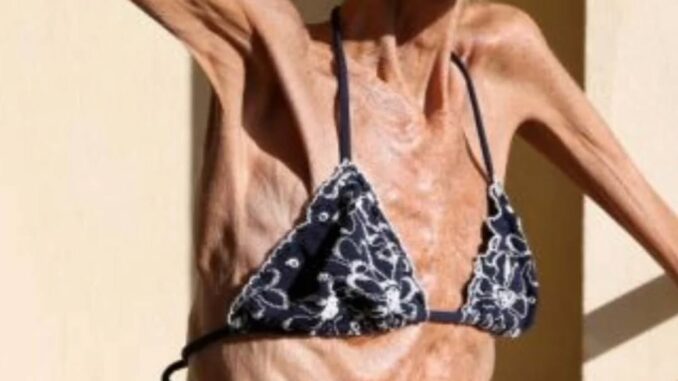
Let’s step past the filters, the curated selfies, and the impossible beauty standards for a moment. Society often values image over substance, equating thinness with success, worth, or desirability, while ignoring the hidden struggles behind appearances.
Valeria Levitin’s story exposes the brutal reality beneath these expectations. Once labeled “the world’s thinnest woman,” her journey is not about sensational headlines but about the deep human cost of chasing societal approval through extreme thinness…
Her story begins long before public attention. Growing up in Russia, Valeria was surrounded by messages—some subtle, some direct—that equated being thin with being valued, teaching her that her worth depended on her body rather than her character…
Family dynamics reinforced this mindset. Parents, relatives, and peers emphasized appearance, often praising weight loss and critiquing natural body shapes. Like many young girls, she internalized these messages, believing self-worth could be earned through dieting and control over her body.
When Valeria moved to the United States as a teenager, the pressure intensified. A new culture with different expectations compounded earlier conditioning, and she began dieting at sixteen, believing that a smaller frame would earn acceptance, confidence, and love.
Her relationship with food quickly shifted from habit to obsession. Dieting was no longer about health but a relentless pursuit of a cultural ideal, one reinforced by peers, media images, and later, the modeling industry she entered in her twenties..
The modeling world treated thinness as currency, yet paradoxically, it demanded more. Agencies criticized her body despite its fragility. Valeria’s weight continued to drop, but she was still told she wasn’t thin enough, reinforcing dangerous behaviors and unhealthy standards.
By her early twenties, Valeria’s health had become critical. Bones weakened, heart function declined, and daily tasks such as walking or sitting caused pain. Despite extreme suffering, she felt trapped by fear, societal expectations, and personal obsession with thinness.
Her weight eventually dropped below 60 pounds, a life-threatening condition. Every bite of food became a battle of both mind and body, and she described feeling like a ghost, a shell of the vibrant person she once was.
Public fascination followed. Media outlets labeled her the “world’s thinnest woman,” sparking intense attention from strangers online. Messages poured in from young girls asking for dieting tips, praising her extreme figure, and idolizing an image that concealed immense suffering.
Leave a Reply